
Home / Services / Interior Work During the Construction Ban
Can interior work continue during the ban? Mostly yes. Here's exactly how much.
Every winter, Delhi NCR homeowners ask us the same question in October: will the construction ban stop my renovation? The short answer is that interiors are the one category of building work that keeps moving through almost every restriction. The long answer depends on the trade, the GRAP stage, and whether your home is in Delhi or Gurugram. This guide is the rulebook our own sites follow from November to February.
Delhi's winter plan is fixed. GRAP is not.
Two separate systems restrict building work in Delhi NCR every winter, and confusing them is the most common reason homeowners get wrong advice. The first is Delhi's own Winter Action Plan with fixed calendar dates. The second is CAQM's Graded Response Action Plan, which applies across the entire NCR and moves with the day's AQI.
| Ban window | Dates (2026–27) | What stops | Interior impact |
|---|---|---|---|
| Dust-generating ban | Nov 1 to Jan 31 | Demolition and outdoor civil construction that generates dust | Indoor trades continue normally |
| Complete C&D ban | Dec 10 to Jan 20 | All construction and demolition in Delhi; trucks carrying sand, cement, bricks or debris barred from entering the city | Interior finishing, plumbing and electrical work continue with dust-control norms |
GRAP can override both rows
The table above is the fixed part. On top of it, CAQM can invoke GRAP Stage III or IV anywhere in NCR on any day Delhi's AQI turns severe, adding stop-work days in November, December, January and February. When GRAP is on, GRAP's list wins.
Delhi is not Gurugram
The fixed December 10 to January 20 complete ban is a Delhi government order; it does not formally apply in Gurugram, Faridabad, Noida or Ghaziabad. Those cities follow GRAP plus their own state directions, which are usually slightly less absolute but still stop dust-generating work.
Want the full winter picture?
Our companion guide covers winter construction and GRAP end to end: construction ban and GRAP rules in Delhi NCR, including the delay math for structural projects and how the 2025 stage revision changed triggers.
What's allowed, what's restricted, what stops.
This is the checklist we run for every interior site in Delhi NCR from November onward. Normal days mean GRAP Stages I and II, when dust rules are enforced but work continues. The Delhi complete-ban column covers December 10 to January 20.
| Interior trade | Normal days (GRAP I–II) | GRAP III, Severe | Delhi complete ban, Dec 10–Jan 20 |
|---|---|---|---|
| Carpentry and joinery | Allowed | Allowed | Allowed |
| Electrical wiring and fittings | Allowed | Allowed | Allowed |
| Plumbing rough-in and fixtures | Allowed | Allowed | Allowed |
| False ceilings and gypsum work | Allowed | Allowed | Allowed |
| Minor MEP welding | Allowed | Allowed (major welding and gas cutting stop) | Allowed |
| Glass, mirrors, hardware, wardrobes | Allowed | Allowed | Allowed |
| Minor indoor repairs: small plaster patches, tile fixes | Allowed | Allowed as exception | Allowed as exception |
| Painting, polishing, varnishing | Allowed | Banned | Banned |
| Tile and stone cutting, marble laying | Allowed | Banned except minor indoor repairs | Banned except minor indoor repairs |
| Demolition and masonry | Allowed with dust control | Banned | Banned |
| Deliveries of sand, cement, debris removal | Allowed, covered | Banned | Trucks barred from Delhi |
| Deliveries of furniture, appliances, modular units | Allowed | Allowed | Allowed |
The occupied-home advantage
Restrictions target dust and pollution, not habitation. Interior finishing in a home people already live in, done with sealed work zones, covered floors and no debris dumping, is the category regulators consistently permit. A raw empty shell getting its first civil work is treated as a construction site; your lived-in flat mostly is not.
The two trades that freeze
Painting, polishing and varnishing stop at GRAP III because of the compounds they release, and CAQM has clarified in a separate order that they cannot be treated as non-polluting. Tile and stone cutting stops because of dust. Everything a luxury interior needs done quietly indoors, from veneer panelling to ceiling coves, keeps moving.
Check the day, not the month
CAQM invokes and revokes stages within 24 hours; Stage III ran for about two weeks in November 2025 and was lifted the day AQI improved. Your contractor should track the daily order, not a monthly assumption. We check before scheduling any dust-generating trade, and so should anyone working on your home.
Four stages, and only the last two touch your home.
GRAP switches on as Delhi's AQI worsens, and since the November 2025 revision the tougher measures kick in one stage earlier than they used to. For an interior project, Stages I and II are paperwork; Stage III changes the trade list; Stage IV is the only one that can genuinely pause work.
| GRAP stage | Delhi AQI | What happens to building work | Interior impact |
|---|---|---|---|
| Stage I (Poor) | 201–300 | Dust-control enforcement begins: covered materials, sprinkling, site audits | Nothing changes |
| Stage II (Very poor) | 301–400 | Strict inspections, anti-smog guns and water sprinkling at active sites, waste trucks checked | Nothing changes, keep the site tidy |
| Stage III (Severe) | 401–450 | Earthwork, piling, demolition, masonry, RMC plants, plaster, painting, tile and stone cutting, and dust-material transport banned across NCR | Fit-out, joinery, ceilings, electrical, plumbing, minor MEP welding continue |
| Stage IV (Severe+) | Above 450 | Essentially all construction stopped; diesel trucks barred from Delhi; only exempt public projects continue | Pause unless the current order permits small interior jobs in occupied homes with dust controls |
Stage III is a sequencing gift
Read the banned list carefully: it removes exactly the noisy, dusty, smelly trades and leaves the craft trades standing. A well-sequenced luxury interior treats Stage III weeks as joinery-and-ceiling season and loses almost nothing.
Stage IV is rare and short
Stage IV needs AQI above 450 and typically lasts days, not weeks. Even then, CAQM's orders have consistently distinguished small interior work in occupied homes from site construction, provided dust is controlled. When in doubt, we simply stand down for those days.
Exemptions won't save a private home
Hospitals, metro, airports, defence and linear public projects get exemptions. Private flats and villas do not. Anyone telling you an exemption applies to your renovation is guessing, and guessing is how sites get sealed.
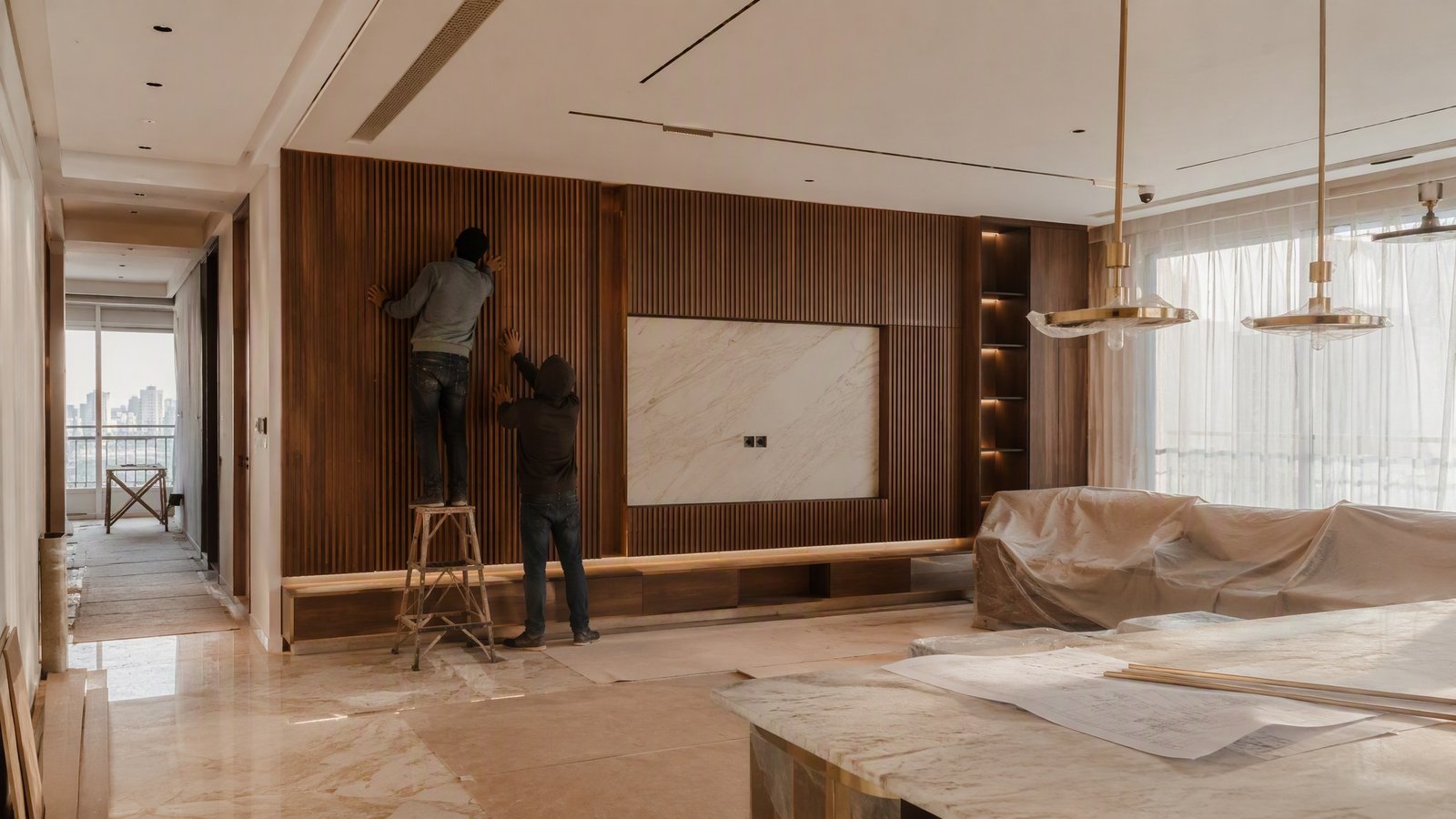
Legal is not the same as fast. Four things still slow you.
Permission to work is only half the winter story. Even when every trade on your project is allowed, the season quietly taxes the schedule in four predictable ways. A realistic plan prices these in from day one.
- Material logistics: dust-material deliveries stop at Stage III, so anything site-mixed or cement-based must arrive early
- Fog-shortened days: November and December mornings shrink the workable window, and NCR highways slow the crews' commute
- Cold curing: polish, adhesive, grout and sealant all take longer below about 10 degrees, even indoors
- Workforce rotation: skilled carpenters and ceiling teams get booked early by builders shifting their own crews indoors, so October booking matters
A winter interior plan that loses weeks, not months.
This is the sequencing we recommend for a luxury flat or villa makeover that spans the restricted season. Swap the trades to match your home, but keep the order: dust-generating work as early as possible, craft trades in the restricted middle, finishing last.
| Month | Restrictions in force | Best work to schedule |
|---|---|---|
| October | None | Demolition, masonry changes, tile and stone cutting; lock material orders and delivery dates |
| Nov 1 – Dec 9 | Delhi dust-generating ban; GRAP stages possible | Civil corrections, tiling, marble laying, first coats of paint; pre-booked furniture deliveries |
| Dec 10 – Jan 20 | Delhi complete ban plus GRAP risk | Joinery, false ceilings, electrical, plumbing, wardrobes, furniture and appliance installation |
| Jan 21 – Jan 31 | Delhi dust-generating ban only | Hardware fitting, minor touch-ups, deep-clean preparation |
| February | GRAP risk only | Painting, polishing, varnishing, final finishes, handover |
GRAP overrides any cell
When Stage III or IV is invoked, dust-generating rows stop everywhere in NCR on that day, whatever the calendar says. The plan absorbs this because the restricted middle is built entirely from permitted trades.
Book the craft teams in October
Every competent builder in NCR moves its workforce indoors in December, and they reach for the same carpenters and ceiling teams you want. We freeze our winter crew roster by mid-October, which is why our indoor schedules hold.
Move-in dates survive
A wedding, a lease end or a school admission usually cannot shift. Tell us your hard date and we build backward from February's finishing window, because that is the one part of winter that never moves.
Four habits that keep a winter site moving.
Ten winters of interiors in Gurugram and Delhi apartments have distilled into a short, repeatable playbook. None of it is exotic; all of it is the difference between a project that drifts and one that hands over on time.
Front-load every dusty trade
Demolition, masonry, tile cutting and plaster patches are scheduled to finish before the first week of November wherever the site allows. What cannot finish early is prepped: materials counted, cut lists drawn, and every dusty task scoped so it takes the minimum possible days when its window opens.
Pre-order and warehouse materials
Modular units, veneer, hardware, sanitary ware and appliances are ordered in October and staged in our storage, so a Stage III order or a truck restriction never idles a carpenter. Only finished goods move in winter, and finished goods are the category that keeps moving.
Run the site like a clean room
Sealed work zones with zip walls, floor protection on every metre of marble and wood, covered debris bins emptied through the society's designated route, and no wet cutting on site. It is how we would treat your home anyway; in winter it is also what keeps the work legal.
Write the honest calendar first
Every winter-spanning project gets a schedule with the ban windows, GRAP-risk weeks and cold-curing allowances already marked, so you see the realistic handover date before you sign, not after the first stop-work order. If a date cannot survive the winter honestly, we say so in October.
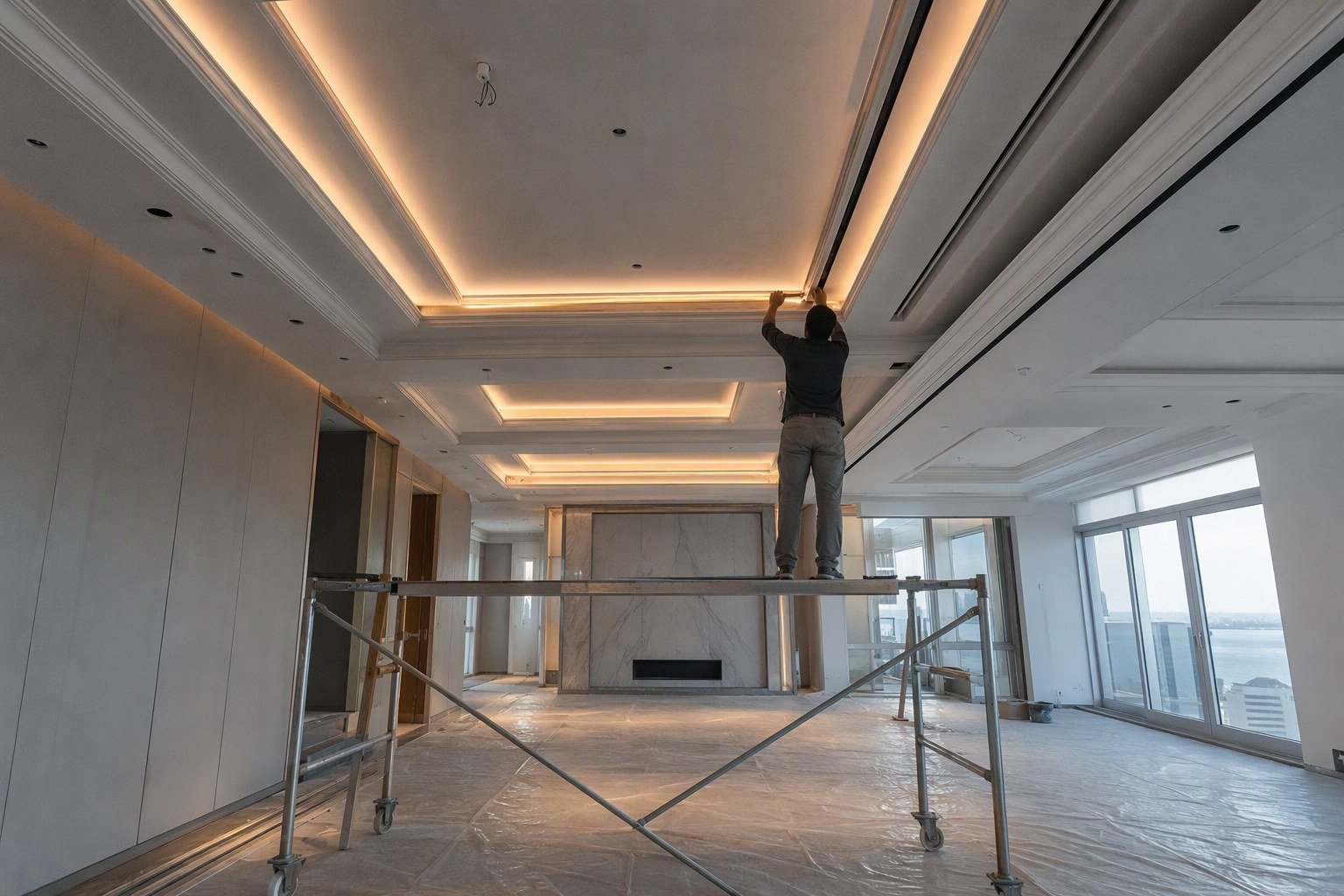
The dust-control checklist inspectors actually check.
Every winter, enforcement teams and RWA security walk the same checklist at renovation sites. A luxury interior passes it easily, because the same habits that protect your Italian marble also keep the site legal. If your contractor cannot show these five things, the schedule is not the only thing at risk.
- Sealed work zones with zip walls or plastic partitioning, so dust stays inside the work area
- Floor and lift protection from the entrance to the site, not just inside it
- All debris bagged and moved through the society's designated route and timings; nothing dumped on roads or in green areas
- Materials stored inside the unit, never in the common area or basement
- No wet cutting or grinding on site; stone and tile cut off-site or in a contained room with extraction
Why DLF and Golf Course Road homes renovate in winter.
Winter is when Gurugram's premium apartment market does its quietest, smartest work. Families are back from summer travel, schools are in session, and the city's best carpentry and ceiling crews move indoors. Societies in DLF Phase 1 to 5, Sushant Lok, Nirvana Country and Golf Course Road see a surge of interior fit-outs precisely in the weeks the headlines call a construction ban, because the people living there know interiors were never the target. The ban targets dust; a disciplined interior site produces almost none.
- Studio in DLF Phase 3, site visits across Gurgaon the same week
- Full renovation scope with dust-controlled sequencing, not just decor
- Fixed-price quotes with the winter calendar priced in, no seasonal surprise

Ban season on the news. Handover season on site.
Everyone told us December was the worst month to start a renovation in Gurgaon. Evas sequenced it so demolition finished in November and the flat was all joinery and ceilings through the ban weeks. We painted in February and moved in on the original date.
The GRAP stage changed twice while our villa was being finished. Nothing on our site stopped, because the team had already moved every dust-generating task to October. The only delay in the whole project was three foggy mornings, which they had warned us about in writing.
We live in Delhi, so the complete ban applied to us literally. The crew worked through it on ceilings, wiring and wardrobes while the neighbour's contractor sat at home. Same building, same rules, very different planning.
The ban, answered plainly.
Yes, largely. Delhi's fixed winter ban stops dust-generating demolition and outdoor civil work from November 1 to January 31, and a complete construction and demolition ban runs from December 10 to January 20. Interior finishing, plumbing and electrical work in occupied homes can continue when dust-control norms are followed. CAQM's GRAP stages apply across the whole NCR including Gurugram: at Stage III, interior fit-out, joinery, false ceilings and MEP work continue while only dust-generating trades stop. At Stage IV, work should pause unless the current order permits small interior jobs in occupied homes with controls. The deciding factor is how the work is done, not where it is done.
No. CAQM's Stage III order explicitly lists painting, polishing and varnishing among the banned activities, and a separate commission order clarified that these cannot be treated as non-polluting because of the volatile compounds they release. Cement plaster and tile or stone cutting are also banned, except minor indoor repairs and maintenance. The practical fix is sequencing: do joinery, ceilings, electrical and plumbing during the restricted weeks, and keep painting and polishing for October, late January and February.
Both regimes overlap. The fixed 42-day complete ban from December 10 to January 20 is a Delhi government order, so it applies within Delhi. Gurugram, Faridabad, Noida, Greater Noida and Ghaziabad follow CAQM's GRAP, which switches restrictions on across the whole NCR whenever Delhi's AQI turns severe. In practice, a Gurugram site faces GRAP Stage III and IV stops on the same days a Delhi site does, while the fixed Delhi-only ban does not formally apply there. Either way, indoor fit-out work remains the safest category through the winter.
Mostly yes, with planning. GRAP Stage III stops the transport of dust-generating materials like sand, cement and debris, and during Delhi's complete ban window trucks carrying such material are barred from entering Delhi. Finished goods such as furniture, appliances, sanitary ware, modular units and paint in sealed cans move more freely. We front-load and pre-order materials in October so indoor trades never wait on a truck, which is the single biggest reason interior projects drift during winter.
Under the National Green Tribunal's polluter-pays directions, a violating site faces compensation of around Rs 50,000 per default plus Rs 5,000 per uncovered vehicle, and repeat violations lead to closure orders under the Environment Protection Act. Delhi additionally monitors large sites through the Dust Portal and AI-enabled cameras. A closure order hurts far more than the fine, because the site cannot restart without explicit permission. A compliant interior site has nothing to fear from inspections.
October and early November are ideal: materials and trades are freely available, and the dust-generating trades can finish before restrictions begin. If you start in November or December, sequence the project so demolition and civil changes finish first, then run joinery, ceilings, electrical and plumbing through the restricted weeks, and keep painting and polishing for late January and February. Homes that follow this sequence typically lose only one to three weeks across the whole winter instead of months.
Tell us your hard date. We will map it around the bans.
Send your floor plan or a description of the makeover, and we will tell you what can be finished before November 1, what can run through the restricted weeks, and whether your move-in date survives the winter honestly. If it does not, we tell you that too, in the first call.
- Replies within one working day
- Site visits across Gurgaon, Delhi and Noida
- Design, execution and finishing from one team