
Home / Haryana Land Pooling Policy 2026
Land pooling · HSVP · HSIIDC · Plotted developmentHaryana Land Pooling Policy 2026: 50 per cent of saleable area for landowners.
The Haryana Cabinet has approved the Land Pooling Policy 2026, a framework for assembling land for urban and industrial projects through the voluntary participation of landowners. Under the new policy, owners will be offered 50 per cent of the total saleable area of the project, replacing the market-value-based formula of the 2022 policy. This guide explains how the policy works, what owners and buyers can expect, and where it differs from what came before.

What the Land Pooling Policy 2026 says.
The essentials of the framework, in plain language.
On 3 November 2026, the Haryana Cabinet approved the Land Pooling Policy 2026. The policy sets out how a development agency, such as the Haryana Urban Development Authority (HSVP) or the Haryana Industrial and Infrastructure Development Corporation (HSIIDC), can assemble land for urban and industrial projects with the consent of the owners, rather than through compulsory acquisition.
Under the policy, landowners will be offered 50 per cent of the total saleable area of the project as per the approved layout plan. In the earlier Land Pooling Policy 2022, the allotment was calculated on the market value of undeveloped land. The remaining 50 per cent of the saleable area is retained by the development agency, which uses it to fund the internal and external infrastructure of the project.
- Voluntary participation: an agency identifies a project area, or a landowner offers land through a registered aggregator
- 50 per cent saleable area: the owner's share is linked to the developed project, not the raw land value
- Public record: identified land, owners and each owner's contribution are published on the agency's website
- Land records protected: a remark is entered in the records and registrars cannot register transactions on the land without the agency's approval
- Consent window: owners must convey consent within 30 days of the allotment share being published
Source: this summary is based on the Cabinet approval as reported on 4 November 2026. The final gazette notification and detailed rules should be checked with the concerned department before any decision is taken.
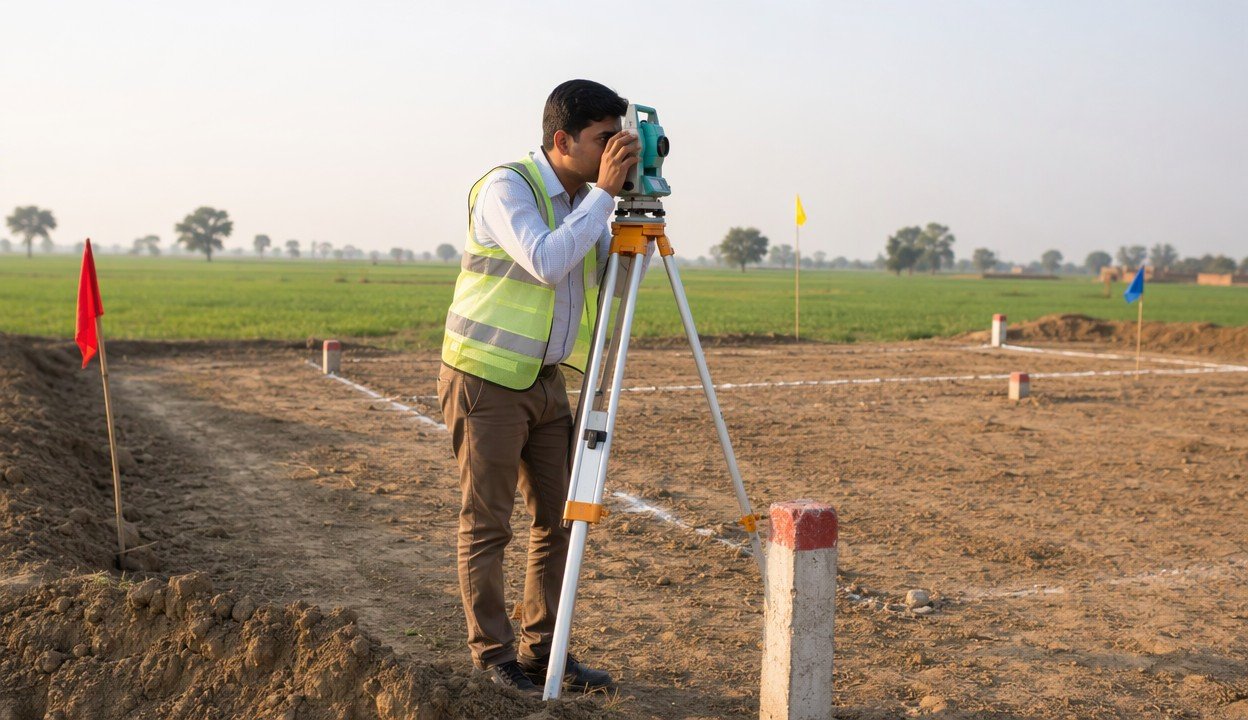
How a land pooling project moves, step by step.
The policy defines a fixed sequence. Each stage has a published deadline and a public record.
Identification and public notice
A development agency identifies the project area, or a landowner voluntarily offers land through a registered aggregator. The agency must give a public notice through advertisements in four leading newspapers, its website, official notice boards, and a notification to the sarpanch or Mayor concerned.
In-principle approval and disclosure
Once the project receives in-principle approval, the agency publishes the details of the identified land, its owners and each owner's specific land contribution on its website. The land records carry a remark blocking transactions without agency approval.
Allotment share and consent
The agency publishes the land allotment share for each owner on its website and in four newspapers. Landowners must convey their consent within 30 days of publication.
Sale deeds within 60 days
Once final project approval is communicated to all contributing landowners, the sale deeds are executed in favour of the development agency within 60 days. Registered aggregators are paid 0.5 per cent of the agricultural collector rate after the deeds are executed.
Infrastructure in four years
The agency must complete infrastructure within four years of final approval. On failure, the land reverts to the owners with an additional compensation of Rs 5 lakh per acre. A one-year extension is possible with the consent of 75 per cent of owners.
What owners receive: plots, kiosks, booths.
The policy fixes minimum plot sizes by category and ties commercial entitlement to the size of the pooled parcel.
| Category | Minimum plot size | Notes for owners |
|---|---|---|
| Residential | 100 sq m | Owners can opt for bigger plots in proportion to their share |
| Institutional | 500 sq m | Allotted as per the approved layout plan |
| Industrial | 250 sq m | Allotted as per the approved layout plan |
| Pooled land parcel | Commercial entitlement | Below the threshold |
|---|---|---|
| Under 999 sq m | No commercial space | Monetary compensation under the 2013 acquisition law or the plot reserve price, whichever is higher |
| 1,000 to 1,999 sq m | One kiosk, 7.56 sq m | Commercial sites are offered out of the landowner's 50 per cent share |
| 2,000 to 2,999 sq m | Two kiosks, 15.12 sq m | |
| 3,000 sq m and above | One booth, 22.68 sq m |
Interim support: owners receive Rs 1 lakh per acre per year for four years from the date of sale deed registration, payable within 15 days. Delay attracts 9 per cent simple interest.
Land pooling 2026, side by side.
How the new framework compares with the 2022 policy and with traditional compulsory acquisition.
| Aspect | Land Pooling Policy 2026 | Land Pooling Policy 2022 | Compulsory acquisition |
|---|---|---|---|
| Owner's return | 50 per cent of total saleable area | Allotment based on market value of undeveloped land | Monetary compensation with solatium |
| Participation | Voluntary consent within 30 days | Voluntary | Not required; notified acquisition |
| Upside linked to development | Yes, share is in developed area | Partially, through value-linked allotment | No |
| Infrastructure deadline | 4 years, with reversion and Rs 5 lakh per acre compensation | As per project schedule | Varies by project |
| Interim support | Rs 1 lakh per acre per year for 4 years, 9 per cent interest on delay | Not defined in the same structured way | Not applicable |
| Commercial entitlement | Kiosks and booths by parcel size slab | Not structured by slab | Not applicable |
What the change means
By moving from a raw land value formula to a share of the developed saleable area, the 2026 policy ties the owner's return to the outcome of the project itself. Owners carry more of the development risk, and potentially more of the upside.
What stays familiar
The basic machinery of pooling is unchanged: voluntary consent, development agencies such as HSVP and HSIIDC running projects, registered aggregators earning a fixed fee, and the 2013 acquisition law remaining the fallback for small or dissenting parcels.
What to watch
The four-year infrastructure deadline with reversion rights, the Rs 1 lakh per acre interim support and the 9 per cent interest on delayed payment are the safeguards that will matter in practice. Whether they are enforced will decide if owners see the 50 per cent share on time.
What the policy means on the ground.
A neutral reading of who is affected and how, around Gurugram and the rest of Haryana.
For landowners
The 50 per cent share can be worth more than a one-time cash award if the developed area appreciates, but it also means waiting through the development period. The structured interim support of Rs 1 lakh per acre per year, the 30-day consent window and the four-year reversion right are the three safeguards to track.
For plot buyers
Pooled and developed plots from agencies like HSVP come with internal infrastructure and clear layout plans, which reduces the uncertainty of buying in unapproved colonies. Buyers should still verify the status of the layout plan and the title before paying any amount.
For people building homes
Anyone planning to build on a plot received through pooling, or buying land in the new sectors around Gurugram, Manesar and Sohna, should budget for construction separately from the plot cost. A realistic per-square-foot estimate for the region is a sensible starting point.
Planning to build on a plot in Gurugram or South Delhi? Use our free construction cost calculator for locality-wise 2026 rates, or read our guide to house construction from scratch in Gurugram.
Interior cleaning services we deliver at handover.
Every build and renovation we hand over goes through a structured interior cleaning scope, done by our own team.
- Post-construction deep cleaning: dust extraction from every surface, channel and groove after civil work ends
- Marble and stone care: grinding, polishing and crystallisation for floors and staircases
- Tile and grout detailing: acid wash, grout whitening and silicone finishing in bathrooms and kitchens
- Glass and facade cleaning: internal and external glass, railings and mirrors, streak-free
- Kitchen degreasing: chimneys, cabinets, counters and appliances cleaned before first use
- Bathroom descaling: fittings, sanitaryware and shower glass restored to a scratch-free shine
- Sofa, curtain and carpet shampooing: fabric and upholstery cleaning for move-in ready homes
- Balcony, terrace and utility wash: including railing polish and drain clearing
- Air conditioning service: filter and coil cleaning before occupancy
- Final handover polish: a room-by-room checklist walkthrough signed off with the client

Local voices on land, plots and building.
What landowners and homeowners around Gurugram and South Delhi tell us when they walk into the studio.
Our family land near Manesar was stuck between offers from brokers for years. When the pooling notification came, we read the whole policy twice. Having someone explain the 50 per cent share and the four-year deadline in plain words before we signed consent helped a lot.
We bought an HSVP plot in the new sectors and had no idea how to budget the build. The team gave us a per-square-foot band, a realistic timeline and a cleaning scope at handover we had not even thought about. The house was dust-free the day we got the keys.
As a buyer the biggest fear is paperwork. The advice to verify the layout plan and title before paying anything saved us from a bad deal in an unapproved colony. Straight answers, no pressure, and they still helped after we said we were only exploring.
The policy, answered.
The queries landowners and buyers search for most, answered from the Cabinet approval details.
The Land Pooling Policy 2026 is a framework approved by the Haryana Cabinet for assembling land for urban and industrial projects through the voluntary participation of landowners, instead of forced acquisition. A development agency such as the HSVP or the HSIIDC identifies a project area, landowners offer their plots, and once the project is developed, owners receive 50 per cent of the total saleable area as per the approved layout plan.
Landowners are offered 50 per cent of the total saleable area of the project as per the approved layout plan. The remaining 50 per cent is retained by the development agency, which uses its share to fund roads, drainage, power, water and other infrastructure. This replaces the 2022 policy, where the allotment was calculated on the market value of undeveloped land.
The minimum size of a developed plot is 100 square metres for the residential category, 500 square metres for the institutional category and 250 square metres for the industrial category. Landowners can opt for bigger plots in proportion to their share of the pooled land.
The development agency must complete infrastructure within four years of final project approval. If it fails, the land reverts to the owners and an additional compensation of Rs 5 lakh per acre is paid to the landowner. A one-year extension is possible if 75 per cent of the contributing owners agree to it.
The core difference is how the owner's share is calculated. Under the 2022 policy, allotment was based on the market value of undeveloped land. Under the 2026 policy, owners receive 50 per cent of the total saleable area of the developed project, which links their return to the final developed value rather than the raw land value. The 2026 policy also sets minimum plot sizes, structured commercial entitlements for mid-size parcels and a defined four-year infrastructure deadline with reversion rights.
Only above certain thresholds. No commercial space is provided for pooled land under 999 square metres. For parcels of 1,000 to 1,999 square metres, one kiosk of 7.56 square metres is offered; for 2,000 to 2,999 square metres, two kiosks totalling 15.12 square metres; and for 3,000 square metres and above, one booth of 22.68 square metres. If the offered land is below 999 square metres, the owner is paid monetary compensation under the 2013 land acquisition law or the plot reserve price, whichever is higher.
Owners receive an annual interim financial support of Rs 1 lakh per acre for four years, starting from the date of sale deed registration, payable within 15 days of each due date. Any delay in payment attracts 9 per cent simple interest. Aggregators registered under the Haryana property dealers law are paid 0.5 per cent of the agricultural collector rate by the agency after the sale deeds are executed.
Building on a plot in Gurugram or South Delhi?
Send us the location and size of your plot and we will respond within one working day with a banded construction estimate, a realistic timeline and the approvals your building will need.
- Replies within one working day
- Locality-wise cost bands for 2026
- Site visits Monday to Saturday, 10:00 to 19:00